

What is the heat transfer mechanism in a Warp Beam Dyeing Machine?
Sep 02, 2025
In the realm of textile dyeing, the Warp Beam Dyeing Machine stands as a cornerstone technology, enabling the efficient and uniform coloring of warp yarns. As a leading supplier of these advanced machines, I am often asked about the heat transfer mechanism at play within them. Understanding this mechanism is crucial for optimizing dyeing processes, ensuring consistent quality, and enhancing overall productivity. In this blog post, I will delve into the intricacies of the heat transfer mechanism in a Warp Beam Dyeing Machine, shedding light on its importance and how it contributes to the dyeing process.
The Basics of Heat Transfer
Before we dive into the specific heat transfer mechanism in a Warp Beam Dyeing Machine, let's first review the fundamental principles of heat transfer. There are three main modes of heat transfer: conduction, convection, and radiation.
- Conduction: This is the transfer of heat through a material or between materials in direct contact. In the context of a dyeing machine, conduction occurs when heat is transferred from the heating element to the dye liquor and then to the warp yarns.
- Convection: Convection involves the transfer of heat through the movement of a fluid, such as a liquid or a gas. In a Warp Beam Dyeing Machine, convection plays a significant role in distributing heat evenly throughout the dye liquor. The movement of the dye liquor, driven by pumps or agitators, helps to carry heat from the heating source to all parts of the machine.
- Radiation: Radiation is the transfer of heat through electromagnetic waves. While radiation can contribute to heat transfer in some industrial processes, it is generally less significant in a Warp Beam Dyeing Machine compared to conduction and convection.
Heat Transfer in a Warp Beam Dyeing Machine
In a Warp Beam Dyeing Machine, the heat transfer mechanism is a complex interplay of conduction and convection. Let's take a closer look at how these processes work together to achieve efficient and uniform dyeing.
Heating the Dye Liquor
The first step in the heat transfer process is to heat the dye liquor to the desired temperature. This is typically done using a heating element, such as a steam coil or an electric heater, located within the dyeing vessel. The heating element transfers heat to the dye liquor through conduction. As the dye liquor absorbs heat, its temperature rises, and it begins to circulate within the machine.
Convection Circulation
Once the dye liquor is heated, convection plays a crucial role in distributing the heat evenly throughout the machine. The movement of the dye liquor is facilitated by pumps or agitators, which create a flow of the liquid within the dyeing vessel. This flow helps to carry heat from the heating source to all parts of the machine, ensuring that the warp yarns are exposed to a uniform temperature.
The convection circulation also helps to prevent the formation of hot spots or cold spots within the dyeing vessel. Hot spots can cause uneven dyeing, while cold spots can result in incomplete dye penetration. By maintaining a consistent temperature throughout the machine, convection circulation helps to ensure that the dyeing process is uniform and reproducible.
Heat Transfer to the Warp Yarns
As the dye liquor circulates within the machine, it comes into contact with the warp yarns. Heat is transferred from the dye liquor to the yarns through conduction. The rate of heat transfer depends on several factors, including the temperature difference between the dye liquor and the yarns, the surface area of the yarns, and the thermal conductivity of the yarn material.
To enhance the heat transfer efficiency, the warp yarns are often wound onto a beam in a specific pattern that maximizes the surface area exposed to the dye liquor. This allows for more effective heat transfer and ensures that the yarns are evenly heated throughout the dyeing process.
Importance of the Heat Transfer Mechanism
The heat transfer mechanism in a Warp Beam Dyeing Machine is of utmost importance for several reasons.
Uniform Dyeing
One of the primary goals of the dyeing process is to achieve uniform coloration of the warp yarns. A well-designed heat transfer mechanism ensures that the dye liquor is heated evenly and that the heat is distributed uniformly throughout the machine. This helps to prevent variations in color and ensures that the final product meets the desired quality standards.
Energy Efficiency
Efficient heat transfer is also crucial for energy conservation. By minimizing heat losses and maximizing the transfer of heat from the heating source to the dye liquor and the warp yarns, a Warp Beam Dyeing Machine can operate more efficiently, reducing energy consumption and operating costs.
Process Control
The heat transfer mechanism plays a key role in process control. By accurately controlling the temperature of the dye liquor and the rate of heat transfer, operators can optimize the dyeing process, ensuring consistent results and minimizing the risk of defects.
Our Warp Beam Dyeing Machines
At our company, we are committed to providing high-quality Warp Beam Dyeing Machines that incorporate advanced heat transfer technologies. Our machines are designed to ensure efficient and uniform dyeing, while also minimizing energy consumption and operating costs.
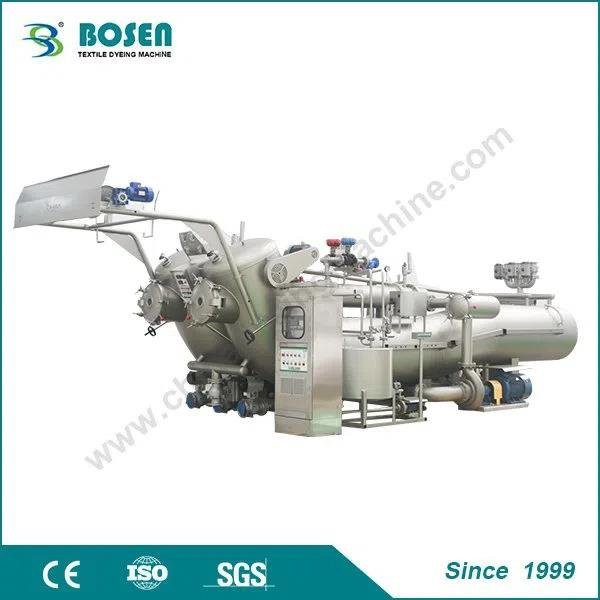

We offer a range of Warp Beam Dyeing Machines, including Soft Flow & Jet Flow High Temperature Dyeing Machine and Liquid Flow & Jet HT Dyeing Machine. These machines are equipped with state-of-the-art heating elements and circulation systems, which ensure optimal heat transfer and uniform dyeing.
Our Warp Beam Dyeing Machine is also designed with user-friendly controls and monitoring systems, allowing operators to easily adjust the temperature, flow rate, and other parameters of the dyeing process. This ensures that the machine can be customized to meet the specific requirements of each customer and application.
Conclusion
The heat transfer mechanism in a Warp Beam Dyeing Machine is a complex and critical process that plays a crucial role in achieving efficient and uniform dyeing. By understanding the principles of conduction and convection and how they work together in a dyeing machine, operators can optimize the dyeing process, ensure consistent quality, and enhance overall productivity.
If you are in the market for a high-quality Warp Beam Dyeing Machine, we invite you to contact us to discuss your specific requirements. Our team of experts will be happy to provide you with more information about our products and services and help you find the right solution for your business.
References
- Incropera, F. P., & DeWitt, D. P. (2002). Fundamentals of Heat and Mass Transfer. John Wiley & Sons.
- Holman, J. P. (2002). Heat Transfer. McGraw-Hill.
- Welty, J. R., Wicks, C. E., & Wilson, R. E. (2008). Fundamentals of Momentum, Heat, and Mass Transfer. John Wiley & Sons.